Saturday, November 29, 2014

You can't breathe in Ulaanbaatar in the winter . . .

Why? Because of the air pollution. Ulaanbaatar is both the coldest capital city in the world and the second most polluted city in the world. And they go hand in hand--the smog is always worse in the winter, because of coal and wood burning (and sometimes trash burning).


At least 1 in 10 deaths are caused by the air pollution, and residents of the ger settlements are exposed to up to double the pollution levels in the city center, and not always with the means to protect themselves from it.

Programs are in place to replace people's current stoves with cleaning burning ones, to build a subway, to build wind farms (the first one in Mongolia is now running outside of Ulaanbaatar). In short, to lower emissions. But those aren't the only solutions. The best solutions involve curbing the population growth of Ulaanbaatar. In my primate city post I mentioned how the existence of primate cities speaks to an imbalance in the infrastructure. If those imbalances are rectified, if rural areas are properly developed and people don't feel like they have to move to Ulaanbaatar to have a hope of survival, then that will also help control the air pollution.

This great article from The Guardian is what I used as my source for this post. I highly recommend it.

Thanks for reading along with me for the past semester! I may or may not write more, but this is the last post inspired by a topic from the latest textbook chapter. I appreciate your support!

Tuesday, November 25, 2014

"Nomad City"

Chapter 13 is about Urban Patterns, the distribution of people and services within a city. And I have been feeling pretty stymied, because Mongolia for me isn't about the cities, it's about the rural way of life and the wide open steppe.

But UlaanBaatar by itself contains almost half the country's population, and it is growing quickly as herders abandon their rural life for the possibilities of the city. So there are huge concerns about city life, and developing a plan to provide or increase basic services for all its residents.

As I was searching for information about how the models of urban structure fit Ulaanbaatar I came across a very cool project: Nomad City. This project is a collaboration between the University of Berlin and the University of Ulaanbaatar and the Goethe Institute in Mongolia. Essentially, it used a ger community on the periphery of the city to test ideas on how to incorporate the ger settlements surrounding Ulaanbaatar into the city and provide city services, including representation and acknowledgement as well as sewer and running water, in a meaningful way. The project began in September 2013 and is now in the documentation phase. And there is a handy YouTube video that talks about the project (it's only about 18 minutes long, but repeats).


The next blog post is going to be about conservation and preservation. When 60% of your residents live in gers and have makeshift heating, there is a LOT of air pollution in Ulaanbaatar.

Sunday, November 23, 2014

Ulaanbaatar, Primate City

In developed countries settlements are arranged in a specific, measurable way, and the location of services can be explained by the Central Place Theory. Developing countries don't have the same distribution of settlements and services that developed countries do, and Mongolia is no different. What Mongolia does have is a primate city: the capital, Ulaanbaatar.

the Ulaanbaatar skyline, with ger shanty towns in the foreground

A primate city is one that has at least twice the population of the second largest city in the country. It is the cultural, political, and economic center of the country and people flock to it for the opportunities it presents.


Ulaanbaatar is the only city listed in the World Factbook as a major population center in Mongolia, and indeed, Erdenet, the next most populated city, has approximately 1/13th the number of people as Ulaanbaatar, according to Wikipedia.

Is a primate city bad for a country? After all, England has theirs (London) and so does France (Paris). A primate city isn't necessarily bad, but it is indicative of some kind of imbalance in the economy or a problem of infrastructure. The thing about primate cities is that because they are just so massive and so culturally and politically important, they suck up a lot of money and services and development that could be used to improve rural life and smaller cities (source). 

Next time I'll be posting more about Ulaanbaatar, probably before Thanksgiving. We're in the home stretch now. Thanks for sticking around!

Saturday, November 22, 2014

We know all about pastoral nomadism, but what about other industries in Mongolia?

A copper mine, from here
According to the World Factbook, the industry sector comprises about 32.6% of Mongolia's GDP. Mining is big business these days in Mongolia, and coal and copper are its biggest products. A lot of the mining development has occurred through foreign companies--primarily Chinese. Mongolia has stepped up oversight of foreign investing recently, though, so that may slow the growth of mining some. A main issue associated with mining is, somewhat predictably, lack of infrastructure. There aren't a lot of paved roads out on the Steppe, and companies are building their own.

In addition to mining, other industries include animal processing, and the cashmere industry. Cashmere is the wool from the Cashmere goat (and other goats) and produces a beautiful soft fabric that is very strong.

Cashemere goats, from here

Hunger, poverty, and climate change

But first, a bit of levity:


With more than 1/4 of the population of Mongolia living in poverty, food insecurity and hunger are huge threats, affecting rural areas more than urban areas--though there are more people in urban areas living in poverty than rural areas, thanks to the migration of the nomads to the urban areas. And while the poverty rate is dropping, it isn't dropping in line with the economic growth in the country.

A lot of food insecurity has to do with the climate. Harsher winter weather is herders to lose many animals, sometimes even entire herds. The herders who give up and move to the city are causing so much urban growth that it is creating a burden on social services. There are too many people in the cities to provide for, and the reduction of the population in the rural areas means that there are fewer services available to those populations as well. There is a lot of instability in the population (both human and animal), and that means that people are hungry.

For more information about hunger in Mongolia, the U.N. Development Project is doing a lot of great work in the country, and their website has been a great resource to me, including this report on the goal of eradicating extreme hunger and poverty.

Also, here is a blog post that brings up a very good point about fighting poverty and hunger: instead of (or in addition to) general hunger programs, we need to look at fighting the cause of poverty, and in the case of Mongolia, this means better preparing the country for the extreme winter weather and improving the emergency infrastructure.

I've been busy with work and other issues in my life, so now I'm a bit behind again on blog posting. Expect to see blog posts on Industry and Settlements/Services this weekend.


Tuesday, November 11, 2014

Developing Mongolia

How do you measure how much a country is developed? Luckily the United Nations does it for us, by compiling the Human Development Index, which tells us what countries are more developed and less developed by looking at three important factors: life expectancy, expected years of schooling, and standard of living, which is measured by dividing the gross national income by the population to get the average contribution to the economy per person.

The most developed country according to the HDI is Norway, with a score of .944 (1.0 is perfect). The least developed country is Niger, at .337. Mongolia's HDI is .698, which places it squarely in the middle of the pack as a medium developing country. In the table below you can see steady improvement since 1980 (the start of the HDI), with the brief exception of 1990-1995 (I wonder if the transition to democracy, even though it was peaceful, has anything to do with that decrease?). In the 30+ years since the start of the figure, Mongolia's life expectancy has increased more than 10 years, the expected years of schooling has increased more than 4 years and the GNI per person has almost doubled.

does not include 2013's numbers, source

And yet, Mongolia's improvements put it below the average for its region, particularly in standard of living (GNI).

Mongolia compared to similar countries and East Asia as a region, source
Based on all I've written about in this blog, I don't think that much of this comes as a surprise. It is a bit more of a surprise, maybe, how well Mongolia does when the HDI is adjusted for inequality, compared to other medium developing countries.  When adjusted for inequality, Mongolia's HDI falls 11.5% but the average for all medium HDI countries is 24.2% and the average fall for East Asia is 21.3% (the U.S. Inequality HDI falls more than 17%, FYI) (source).

The next chapter of the book is about food and agriculture (mmm, food, NOT), so that might be my next post, but I might also be inspired to talk about fair trade and world trade before then. It depends on how busy my week is. But either way, I will see you next time!


Sunday, November 9, 2014

"An empire of the land"

Mongol Empire map
The growth of the Mongolian Empire, from here.


a map of the Eurasian Steppe, from Encyclopedia Britannica

Chapter Eight of our textbook is about political geography, so I'm taking the opportunity to make good on a tease in one of my early posts, about the secret to the Mongolian Empire's success.

Early on I said that the Eurasian Steppe was the secret to the Mongolian Empire's success. If you look closely at the two maps I've posted above, you can see that the spread of the Mongolian Empire generally follows and then spreads north and south of the Eurasian Steppe. The Mongols laid waste to a huge area, killing millions of people in the process, and they were fueled by grass. They possessed huge herds of cattle, camels, and horses, and did everything from horseback ("If a Mongol had to move any distance farther than a hundred paces, he jumped on a horse and rode.").  Genghis Khan first united clans of the Steppe to begin their invasions, and they used the resources of the Steppe with great efficiency, until the technology of cannons caught up to them. The author of the above linked article calls them "solar powered, an empire of the land."

I don't mean to play down the destruction the Mongols caused in their invasions, but after the killing it wasn't all bad. The Empire absorbed different cultures, was tolerant of different religions, and was well organized with a strong set of laws that in some places lasted for centuries.

The article I linked above, "Invaders", is a fascinating read I would recommend. It puts the war in Iraq and against Al Qaeda (from 2005, though) into the context of the Mongols' destruction of Baghdad in 1258.  

Also, because it's available, here's a BBC program about Genghis Khan and the Mongol hordes.


And with this entry I'm all caught up! I will continue posting once or twice a week until the end of the semester. Later on this week, I'll talk about the standard of living in Mongolia and other indicators of its development.

Thursday, November 6, 2014

Mongolia: A homogenous kind of place.

Here's a picture of an adorable Mongolian toddler, just because.
Mongolia doesn't have a lot of ethnic drama. Fully 90% of the population is ethnic Mongol and the biggest minority population is Kazakh--a whopping 4%--largely concentrated in the western provinces and around Ulaan Baatar.  According to all the sources I looked at, there is very little strife between the Mongols and Kazakhs. Not a lot of mixing, but definitely a cordial relationship (this is confirmed by both Mongols and Kazakhs, too, not just Mongols (252).

The large population of Kazakhs in Mongolia might seem surprising. After all, they don't share a border. But here's a map that shows the relationship between the Kazakhs and Mongolia.


Kazakhstan and Mongolia sort of touch fingers, and geographically it's easy to cross between countries. And while Kazakhstan was a part of the Soviet Union travel between the two countries was nothing at all. It's much more difficult now, but since Kazakhstan's independence people migrate much more than they used to, to take advantage of business or educational opportunities.

But while there is little strife within Mongolia's people, this doesn't mean there isn't ethnic and racial tension, mostly between Mongolians and the Chinese. The history between Mongolia and China isn't very cordial, and I mentioned in my last post that Mongolians don't tend to like the Chinese all that much. The thing is, in the current economic climate, Mongolia and China have a closer relationship than ever in modern history, and that is resulting in insecurity and definite wariness of Mongolians about China's motives. They don't want to become part of China again.

So, we've almost caught up with the book now. I'm not sure what I'm going to write about next time, but you can expect another post tomorrow night or Saturday, and I'm pretty sure it will have something to do with the human geography of Mongolia. See you then!

Wednesday, November 5, 2014

Religion in a former socialist state

A monk at the oldest Buddhist monastery in Mongolia, from here.
One of the things that Genghis Khan was famous for while he was conquering the world was his religious tolerance, believe it or not. He allowed all sorts of religions to be practiced in his territory, and though a shamanist he was very interested in Daoism. Eventually Buddhism would become the major religion of Mongols.

But Mongolia was led by communists from 1911-1991. And it was not immune to the atheism and religious purging that occurs with communist leadership. Much religious culture was destroyed along with most temples, and many monks were killed. Religion completely disappeared from public view in Mongolia.

And then a funny thing happened.

There was a peaceful transition to a democratic government.

And all of a sudden monasteries were restored. Monks became a part of daily life again, rural people practiced Shamanism, and the Kazakhs of the west practiced Islam again. There was very little drama regarding the reinstatement of religion.

There are still aftereffects, though. The World Factbook estimates that 38% of the population claims no religion, while 53% are Buddhist, 3% are Muslim, 3% Shaman, and 2% Christian.

Next time we'll discuss ethnicity in Mongolia. Did you know that according to a 2003 study as much as .5% of the world's male population is directly descended from Genghis Khan? 


Tuesday, November 4, 2014

How do you say "blog" in Mongolian? I have no idea . . .

Before I knew much about Mongolia, I assumed that they would speak Mandarin, as a remnant of China's history in Mongolia. But, also based on that history (The Qing Dynasty ruled Mongolia for over 200 years), Mongolians don't really like the Chinese much, and they don't speak Mandarin.

The official language of Mongolia is Mongolian! I know, it's hard to believe. Mongolian is a member of the Altaic language family (the most common Altaic language is Turkish). I have heard rumors that there are plans to change the written language from Cyrillic to Latin (again--they used the Latin alphabet very briefly in the 1940s), but I couldn't find anything official to support that.

Since Mongolians don't speak Mandarin, do they speak any other languages? It depends. Educated people do speak a second language. I found a very interesting conversation on LinkdIn about the prevalence of Russian versus English . This is completely anecdotal, based on the conversation's participants' experiences, but it seems like what language is spoken depends on the age of the speaker. Many people speak Russian as a second language, especially if they were educated (Mongolia was a socialist state with close ties to the Soviet Union for 70 years). But it is mostly the older generations who speak Russian. Younger generations are less interested in Russian and more interested in English (I have an acquaintance who taught English in Ulaan Baator). From all the official information I've read, English is never mentioned as a second language, but it seems like it is becoming more popular--the global language indeed.

Do you want to learn a basic greeting and how to introduce yourself in Mongolian? Of course you do! Luckily I have another handy YouTube video that tells you how:


Coming up next time, I'll talk about the religions of this former Socialist state.

Sunday, November 2, 2014

Traditional craft in Mongolia


Chapter 4 of our textbook talks about folk culture versus popular culture. Culture is essentially two different types: types stemming from daily necessities like shelter and food, and types involving leisure activities. A part of folk culture that I’m particularly interested in is traditional crafts.
Mongolia has a rich and vibrant folk culture tradition, probably because of its rich rural, nomadic, pastoral history.  Two traditional crafts associated with nomadic culture are felt making and embroidery.


Felt making began and is still practiced today as a part of providing shelter.  Nomads make felt to cover their gers (yurts) and make carpets shoes, cushions and other decorative items with it ( http://www.feltmongolia.mn/traditinoal.html).
handmade felt slippers from here.

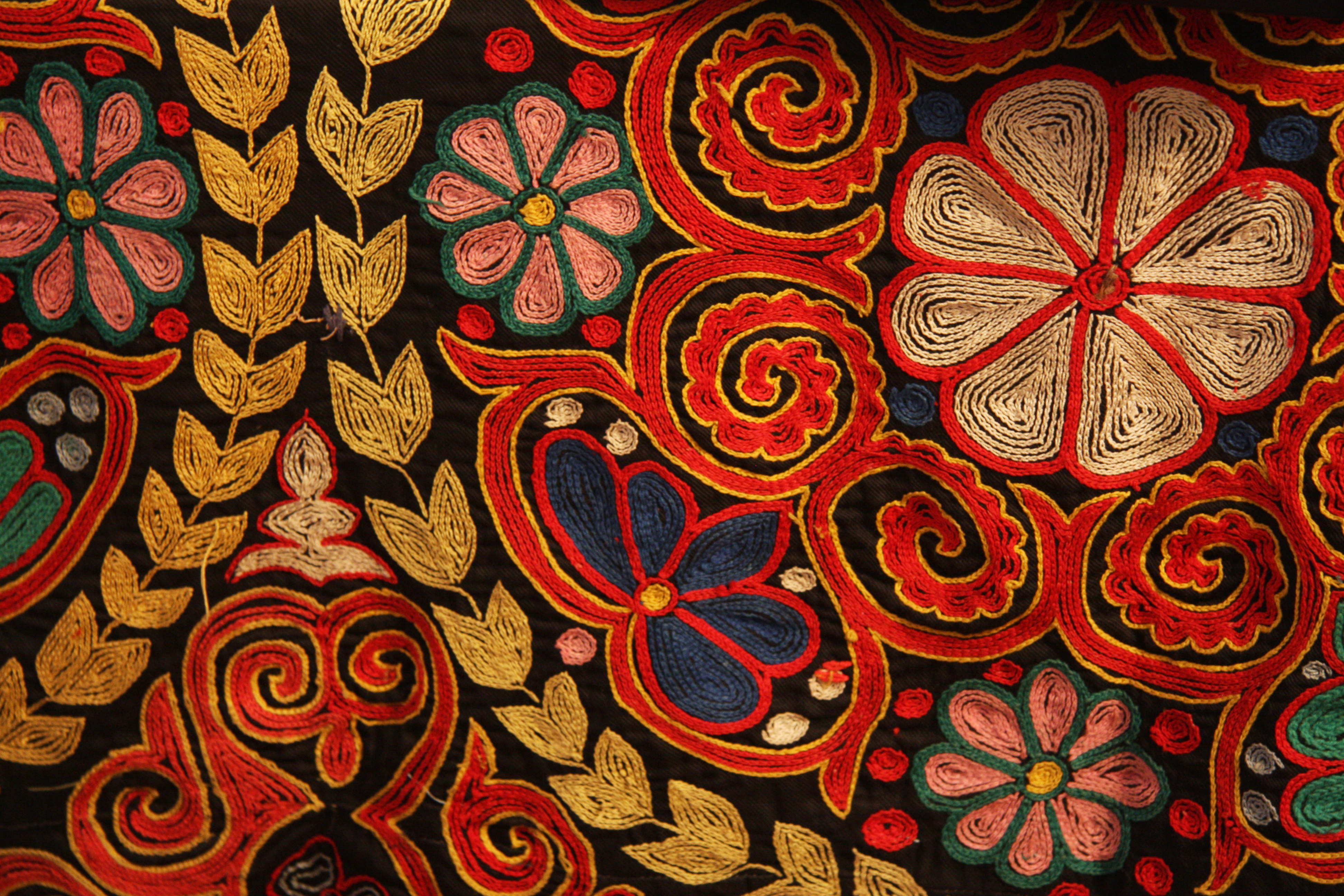
Embroidery is also tied to the ger, particularly in the west where the Kazakhs are more prevalent. Mongolian embroidery primarily uses a chain stitch to outline the design and to fill it in.  Embroidery pieces are for decoration, to hide the wood frame of the ger and to add warmth to a home. Mothers begin embroidering wall hanging for their children’s wedding when they are still small.

embroidery on a Kazakh rug purchased in Mongolia. 


a traditional wall hanging


In the above picture, you can see that the wall hanging is unfinished. There are a couple reasons for that--there is a signature/inscription at the bottom, the bottom will not be seen so doesn't need to be finished, and also as a reflection of their Muslim faith (only God creates perfect things). 


Next time, we'll talk about the language of Mongolia. 

Saturday, November 1, 2014

Urbanization. From nomads to city dwellers.

http://www.boston.com/bigpicture/2012/12/mongolias_nomads.html

The picture above of a Mongolian man herding his animals from his motorcycle links to a gorgeous photo essay at The Boston Globe. The photos are part of Taylor Weidman's Vanishing Cultures Project, which documents threatened indigenous ways of life, including the Mongolian nomad.

In the video at the end of my last post, there was an elderly woman who lived in a ger on the edge of Ulaan Baatar. She lived in a traditional nomadic tent in a permanent place, without running water at the edge of a huge city in a community of other former nomads.  This is happening a lot. Mongolia's urbanization rate is almost 3%. Nomads are giving up their way of life for a variety of reasons.

  •  Political pressures. For a culture that is so reliant on agriculture, Mongolia's governments have put a lot of pressure on nomads, making it harder and harder to move around, putting strict limits on where and when nomads can move, changing nomadic routes that had been established for generations. This pressure is by no means a current issue, it's been happening since Chinese rule starting at the end of the 15th century. It became worse with the collectivism of the Socialist regime of the 20th century, though. (The Geography of Mongolia and its Cultural Effects lists my sources for this information--very interesting reading!)
  • Meteorologic pressures. The climate in Mongolia is changing. Winter storms are getting worse, which threatens herds. Also, droughts are now a more common occurrence, which threatens pastures. With the harsher winds, the topsoil is being blown away, which means that the Gobi desert is expanding. Even relatively mild winters can have localized storms that can be devastating to a nomadic family. 
  • Economic pressures. Nomads are poor, and the more stress put on the herds (due to other pressures) the less money they make.  They have shown themselves to be adaptable, using solar power and tech gadgets when they have them, but there's also the fact that globalization has come to Mongolia, too, and its economy is diversifying.  There is less money in agriculture and more in mining, with multinational corporations running mines and smaller local mines also operating. 

 Next time at Each Meadow, watch out, I'm going to talk about the traditional crafts of Mongolia and folk culture.


Friday, October 31, 2014

Who is Mongolia?

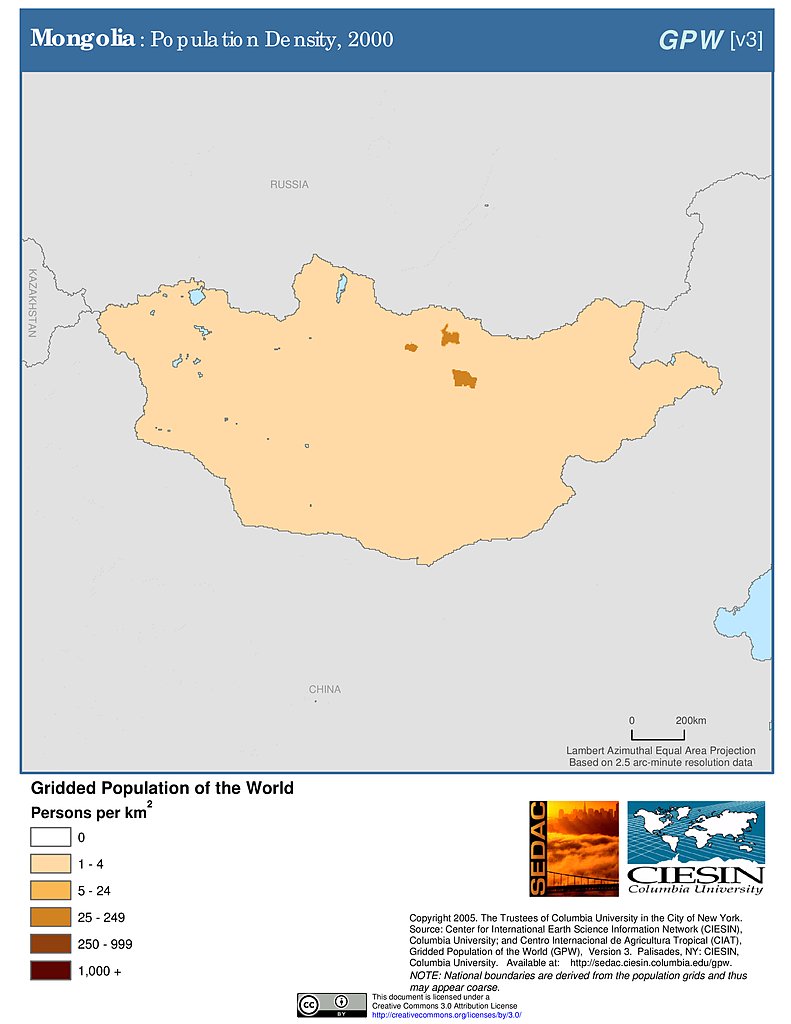
This is a very cool link. It goes to a wikipedia page that ranks countries by population density. I know, I know, it's wikipedia, but the source for the data is linked right in the table (and the Mongolia numbers are accurate, so . . . ).

The most densely populated country? Macau (though it's part of China in the same way Hong Kong is). The United Kingdom is 15th. The U.S? 180th, with about 84 people per square mile. 

Mongolia is 238 of 242, with about 4 1/2 people for every square mile of land. To say it's mostly rural is putting it pretty mildly, I think.

Here's a pretty (empty) map:


So who lives in this mostly rural, isolated place? Almost 3 million people live in the country, and more than a million of them live in the capital city of Ulaan Baatar.  That is 40% of the overall population! In fact, nearly 70% of the population lives in urban areas. The other 30% are nomadic, herding sheep, cows, goats, and horses.

This is the population pyramid of Mongolia (from the World Factbook again):


The average age of a Mongolian person is 27.1 and it's growth rate is 1.37%, 89th in the world. So it's young, and growing.

I was also surprised by the education rates: more than 97% of the population can read and write, and the average person receives 15 years of schooling.

Mongolia has high unemployment and their way of life is changing a lot, which is challenging. Finally, here's a video about the pressures facing traditional Mongolian nomadic life.


Up next, a closer look at nomadic life and migration.

Thursday, October 30, 2014

Where is Mongolia?

There are a lot of answers to that question, believe it or not, and it depends on the context.

  • Mongolia is in northern Asia.
  • Mongolia is surrounded by China (on the south, east and west) and Russia (on the north). 
  • Mongolia is between the latitudes 41-52 degrees N and longitudes 87-120 degrees E. This puts it at around the same latitude as Calgary, Alberta, for example. 
  • Mongolia is mostly in the UTC+8 time zone; the far west is in UTC+7. This means when it's 9:00 pm here in Cheyenne, it's 11:00 am the next day in most of Mongolia.
  • Mongolia is on the eastern edge of the the Great Steppe--a huge semiarid prairie that stretches from Mongolia to Ukraine. The steppe is punctuated by mountains in the west, and the Gobi desert in the south.  The steppe is also the secret to the Mongol Empire's success, but that will be a story for another time. 

Mongolia in the context of the Earth


Mongolia in the context of Asia (that blue wedge between the giant purple Russia and the giant yellow China)

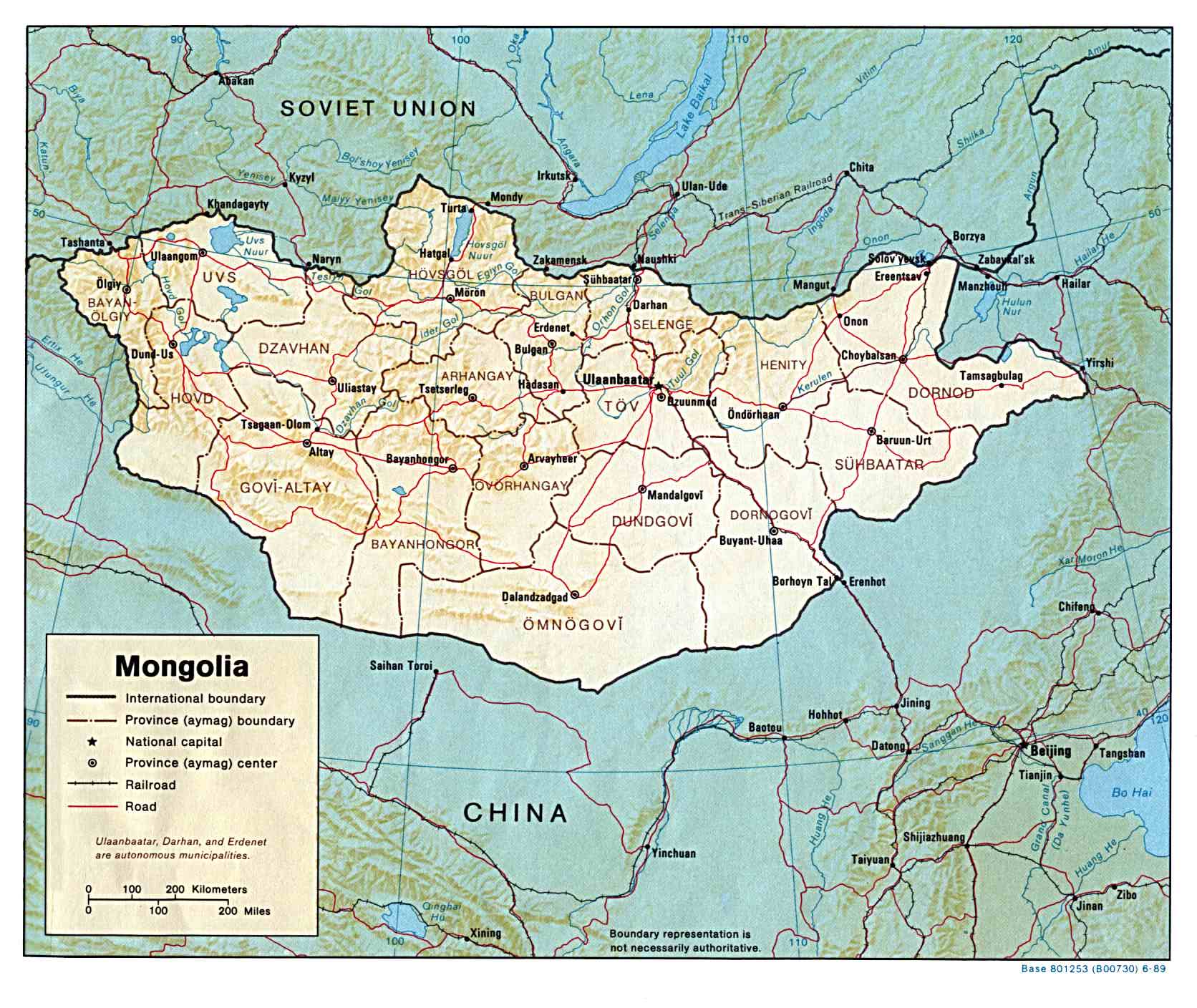
Mongolia in 1989 You can see the Altay Mountains in the West and the Gobi Desert in the South.
       

Links:
See the World Factbook for some basic information about Mongolia. Also, check out History of the Steppe for more information about the Eurasian Steppe


Coming up (probably) tomorrow: demographics! Who lives in Mongolia, where do they live and what do they do?

Wednesday, October 29, 2014

So. Why Mongolia?

I have this thing about Mongolia. I'm not even sure why. I just want to go there so badly, and am completely captivated. This is handy when you aren't sure what to write about in Geography courses or are asked to learn about a country for an intro to business course.

So, Mongolia. Did anyone see the Mongolia episode of Long Way Round?  The scenery was breathtaking and so desolate, but I think the real start to my obsession with the country was through reading a blog in 2009, about a couple who decided to bicycle across Europe and Asia for two years. The pictures and stories about Mongolia were just amazing. This is the first page of their Mongolia blog. Now, every time I get to pick a country to study or write about, this is the place. Someday I will get there.

I took Physical Geography last fall and I wrote my final paper on Mongolia (and really enjoyed writing it, too). Mongolia is famous for Genghis Khan and Mongol Hordes that went conquering in the 12th century and also for its nomadic culture, and even today almost a third of the country is still nomadic. It has an interesting relationship (read: tension) with its mega-neighbors Russia and China, and in the 1990s peacefully transitioned from a socialist government to a democratic one. There's so much to discover about this vibrant land, and how better to do it than through Human Geography? 

Links:

Long Way Round,  a documentary that followed Ewan McGregor and Charley Boorman as they rode motorcycles from London to New York, including through Mongolia.

The Biking Barkleys, a couple who spent their 2-year honeymoon biking from Kazakhstan to the Czech Republic via Asia.  

The Geography of Mongolia and its Cultural Effects,  my final paper for Physical Geography, Fall 2013.